Countering US Offensive Realism: Strategic Autonomy in an Age of Hegemonic Competition
 Countering US Offensive Realism: Strategic Autonomy in an Age of Hegemonic Competition


Penulis

Introduction
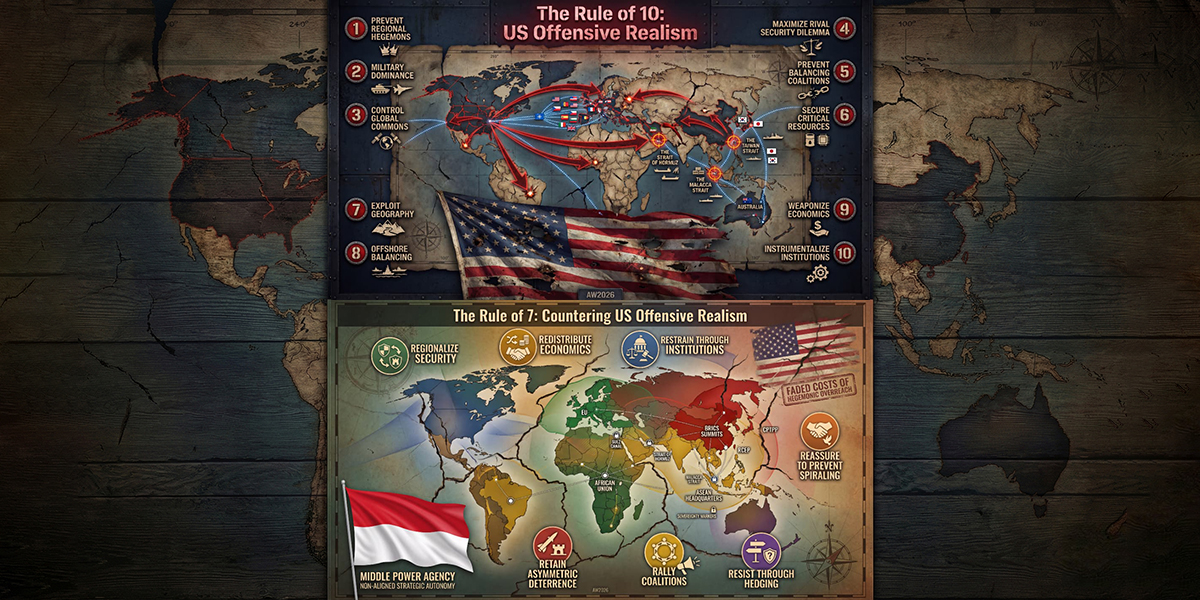
The post-Cold War unipolar moment has given way to an era of renewed great power competition, with the United States employing what can be characterized as offensive realist grand strategy to maintain its primacy. This essay examines the logic driving American hegemonic behavior through ten observable rules of power maximization, then proposes seven counter-strategies (the “7 Rs”) that middle and major powers can employ to preserve international stability without triggering catastrophic confrontation. The central argument is provocative yet necessary: the greatest threat to global stability may not be challengers to American power, but rather the structural incentives embedded in offensive realism itself—incentives that push the US toward preventive actions that could prove counterproductive to its own security.
Part I: The Rule of 10—Decoding US Offensive Realist Strategy
The Hegemonic Imperative
Offensive realism, most comprehensively articulated by John Mearsheimer, posits that great powers are condemned to compete for power in an anarchic international system where no higher authority can guarantee survival. According to this logic, rational states seek to maximize their relative power, with regional or global hegemony as the ultimate security guarantee. The United States, having achieved regional hegemony in the Western Hemisphere by the early 20th century and global primacy after 1991, now operates according to rules designed to preserve and extend this dominance.
Rule 1: Prevent the Rise of Regional Hegemons.
The cornerstone of US grand strategy since World War II has been preventing any single power from dominating Europe, Asia, or the Middle East. This explains American interventions from the Marshall Plan and NATO expansion to the “pivot to Asia” and maximum pressure campaigns against Iran. A peer hegemon in any region
could consolidate resources to challenge American global dominance—precisely what the US did after achieving hemispheric hegemony. China’s rise represents the most significant test of this rule, driving intensified containment efforts including technology export controls, alliance strengthening, and military posture adjustments.
Rule 2: Maintain Nuclear Superiority and Conventional Dominance.
Despite nuclear parity with Russia and China’s growing arsenal, the US continues pursuing qualitative advantages through hypersonic weapons, cyber capabilities, and space- based systems. The $886 billion defense budget (2024) exceeds the next ten countries combined, reflecting the offensive realist conviction that military power remains the ultimate arbiter of international politics. This spending is not defensive paranoia but calculated hegemonic maintenance.
Rule 3: Control the Global Commons.
American naval dominance, eleven carrier strike groups, global basing network, and GPS infrastructure ensure that the US can project power anywhere while denying adversaries the same capability. Freedom of navigation operations in the South China Sea, despite no direct territorial claims, demonstrate commitment to controlling maritime chokepoints through which 80% of global trade flows.
Rule 4: Maximize the Security Dilemma for Rivals.
NATO expansion, AUKUS, the Quad, and bilateral defense treaties create a network forcing Russia and China into costly multi-front defense planning. Rather than alleviating competitors’ security concerns, this rule deliberately exacerbates them, compelling adversaries to divert resources from economic development and power projection into immediate territorial defense.
Rule 5: Prevent Balancing Coalitions.
Despite common interests, Sino-Russian cooperation remains limited by mutual suspicions carefully cultivated through American diplomacy. The US offers selective reassurance to India regarding China, to Europe regarding Russia, and maintains sufficient engagement with both Beijing and Moscow to prevent full alliance consolidation against American hegemony.
Rule 6: Secure Energy Independence and Critical Resources.
The shale revolution transformed US energy security, while the CHIPS Act and infrastructure investments aim to dominate semiconductor supply chains. Simultaneously, sanctions and export controls deny rivals access to critical technologies, creating asymmetric dependencies that can be weaponized during crises.
Rule 7: Exploit Geography as Strategic Advantage.
Protected by oceanic buffers, the US has not faced foreign invasion since 1812, allowing it to fight wars abroad without homeland devastation. Forward deployment in Europe, Asia, and the Middle East keeps conflicts away from American soil while placing US forces on rivals’ peripheries—a geographic luxury unavailable to land powers like Russia or China surrounded by hostile neighbors.
Rule 8: Use Offshore Balancing Selectively.
While maintaining ultimate military superiority, the US increasingly shifts burdens to allies. Calls for European strategic autonomy, Japanese rearmament, and Australian nuclear submarine acquisition represent managed burden-sharing that preserves American dominance while reducing costs.
Rule 9: Weaponize Economic Interdependence.
Dollar hegemony, SWIFT access, and technological dependencies become instruments of statecraft. Secondary sanctions compel third parties to choose between American markets and targeted adversaries—a choice most make in Washington’s favor. This transforms globalization from a web of mutual vulnerability into asymmetric leverage.
Rule 10: Instrumentalize International Institutions.
The US helped create the UN, WTO, and international legal frameworks not as constraints on its own power but as mechanisms to legitimize preferred outcomes and constrain adversaries. When institutions serve American interests, they are invoked as sacred; when they don’t, they are bypassed or ignored—witness Iraq 2003, rejection of the International Criminal Court, or trade wars conducted despite WTO rulings.
The Self-Defeating Logic
These ten rules reveal offensive realism’s internal contradiction: the very strategies meant to ensure security generate the threats they seek to prevent. By maximizing power, the US validates rivals’ worst fears, making cooperation impossible and conflict increasingly likely. China’s military modernization, Russia’s revanchism, and even middle power hedging reflect rational responses to perceived American aggression, creating the security spirals offensive realism predicts but cannot escape.
Part II: The Rule of 7—Strategic Recommendations for Countering Hegemony
If American offensive realism is the problem, what solutions exist that don’t simply replicate the same competitive dynamics? The following seven counter-strategies offer middle and major powers pathways to preserve autonomy and stability without triggering great power war.
R1: Regionalize Security Architecture.
Rather than accepting US-dominated global security frameworks, states should develop robust regional mechanisms for dispute resolution and collective defense. ASEAN’s centrality in Southeast Asian security, despite lacking NATO’s military integration, has prevented great power domination by maintaining institutional neutrality. The African Union’s peace operations, however imperfect, represent indigenous conflict management reducing pretexts for external intervention.
The key is creating regional ownership of security challenges. When Europe outsources defense to NATO (read: American) leadership, it perpetuates dependency. Macron’s appeals for European strategic autonomy recognize that genuine security requires capability without seeking American permission. Similarly, Gulf states developing independent defense capabilities reduce both their vulnerability to abandonment and their utility as staging grounds for US power projection.
R2: Redistribute Economic Dependencies
Dollar weaponization has accelerated de-dollarization efforts, but this requires more than rhetoric. China’s Cross-Border Interbank Payment System (CIPS), bilateral currency swap agreements, and digital yuan experiments create alternative transaction mechanisms. BRICS expansion and discussions of a common currency reflect growing recognition that economic sovereignty requires financial infrastructure independent of Washington’s control.
Supply chain diversification proves equally critical. Over-reliance on any single economic partner—whether the US or China—creates vulnerability. The EU’s “de-risking” strategy toward China, while maintaining engagement, exemplifies intelligent hedging. For developing nations, participating in multiple trade frameworks (RCEP, AfCFTA, Mercosur) rather than betting on a single patron reduces exposure to economic coercion.
R3: Restrain Through Institutional Binding
International institutions cannot prevent great power action, but they can raise its costs. Russia’s invasion of Ukraine triggered unprecedented diplomatic isolation and economic sanctions partly because it so flagrantly violated UN Charter principles. Even cynical powers care about legitimacy—not from moral conviction but because legitimacy reduces resistance costs and facilitates cooperation.
Middle powers should therefore strengthen rather than abandon multilateral frameworks. When the US withdrew from the Iran nuclear deal, European persistence with the JCPOA complicated American maximum pressure. When Washington rejected the Paris Agreement, continued global implementation maintained climate architecture. The goal is not constraining American power absolutely but making unilateral action more costly and multilateral cooperation more attractive.
R4: Reassure to Prevent Spiraling
Offensive realism assumes worst-case intentions, creating self-fulfilling prophecies. Transparency mechanisms, confidence-building measures, and communication channels can interrupt these spirals. The Incidents at Sea Agreement between the US and Soviet Union prevented naval confrontations from escalating during the Cold War. Modern analogs include crisis hotlines, prior notification of military exercises, and mutual observation of strategic weapons facilities.
China’s opacity regarding military capabilities and strategic intentions feeds American threat perception. Greater transparency—without sacrificing legitimate security—could reduce miscalculation risks. Similarly, Russian complaints about NATO expansion, however strategically self-serving, pointed to real security concerns that might have been addressed through institutional arrangements rather than dismissed as propaganda.
R5: Resist Through Strategic Hedging
Total alignment with either the US or China forces nations into subordinate positions within hegemonic competitions. India’s strategic autonomy—maintaining security cooperation with Washington while expanding trade with Beijing and purchasing Russian weapons—demonstrates hedging’s power. Vietnam, invaded by both China and the US within living memory, now engages both economically while maintaining independent defense capabilities. Hedging requires sufficient capacity to matter. Small states may lack leverage, but middle powers collectively represent significant economic and diplomatic weight. Indonesia, Brazil, Turkey, Saudi Arabia, and South Africa pursuing independent foreign policies complicate great power calculations by denying exclusive alignment. The Non-Aligned Movement’s Cold War legacy offers lessons: refusing to choose sides preserves autonomy even when individual members lack superpower strength.
R6: Rally Coalitions Around Shared Interests
Rather than permanent alliances that trigger balancing responses, issue-specific coalitions allow cooperation without confrontation. Climate change, pandemic response, cyber governance, and space exploration present opportunities for collaboration cutting across geopolitical divides. These forums dilute American dominance through collective action while avoiding the zero-sum dynamics of military alliances.
The Shanghai Cooperation Organization, despite limited military integration, creates an alternative diplomatic space where Central Asian states engage China and Russia without excluding future cooperation with the West. Technology standard-setting bodies allow developing nations to shape global digital infrastructure rather than accepting Silicon Valley or Shenzhen defaults. These mechanisms don’t directly challenge US hegemony but create spheres where American preferences don’t automatically prevail.
R7: Retain Asymmetric Deterrence
Matching US conventional military spending is economically impossible and strategically unnecessary. Instead, states should develop capabilities imposing unacceptable intervention costs. China’s anti-access/area denial systems don’t defeat the US Navy globally but make intervention near Chinese shores prohibitively expensive. Russian cyber capabilities, Iranian irregular warfare expertise, and North Korean nuclear weapons represent asymmetric deterrents against vastly superior conventional forces.
For non-nuclear states, controlling critical infrastructure, resources, or chokepoints provides leverage. Saudi Arabia’s oil production capacity, Taiwan’s semiconductor dominance, or Indonesia’s position astride critical maritime routes create dependencies that deter coercion. The goal is not defeating American power but making its exercise sufficiently costly that negotiation becomes preferable to confrontation.
Part III: Stability Through Managed Competition
The provocative reality is that unchecked American offensive realism may pose greater systemic risks than any challenger. Hegemonic powers facing relative decline historically become more aggressive, not less—witness Britain’s pre-WWI naval race or France’s revolutionary wars. A United States convinced it must prevent any peer competitor at all costs might choose preventive war while advantages remain, particularly if decision- makers internalize offensive realist logic that cooperation is impossible and decline inevitable.
The Rule of 7 offers an alternative: not naive cooperation ignoring power realities, but managed competition accepting that multiple centers of power can coexist without catastrophic war. Historical precedents exist—the Concert of Europe maintained relative peace for decades through recognized spheres of influence and crisis management mechanisms. Nuclear deterrence prevents great power war not through hegemony but through mutual vulnerability recognition. Contemporary stability requires acknowledging what offensive realism denies: that security can be mutual rather than zero-sum, that international institutions matter beyond pure power calculations, and that identities and interests are not fixed but constructed through interaction. These insights don’t eliminate competition but suggest it can be channeled through non-violent means.
Conclusion: Beyond Offensive Realism
The Rule of 10 describes observable American behavior, but it need not be destiny. The Rule of 7 provides pathways for other actors to shape international order without either submitting to hegemony or triggering great power war. The choice facing the United States is whether to continue pursuing primacy in a multipolar world—a strategy likely to generate the very balancing coalitions it fears—or accept managed competition within institutionalized frameworks that preserve core interests while accommodating others’ legitimate security concerns.
For middle powers and rising challengers, the choice is whether to directly balance against American power, risking confrontation, or to pursue the more subtle strategies of regionalization, redistribution, restraint, reassurance, resistance, rallying, and retention that preserve autonomy while maintaining engagement.
The greatest danger is not American power per se but the offensive realist philosophy animating its exercise—a worldview that sees cooperation as weakness, institutions as facades, and perpetual competition as inescapable. Countering US offensive realism requires demonstrating that alternative logics are not merely morally preferable but strategically viable. Only then can the international system escape the tragedy that offensive realism simultaneously predicts and produces.