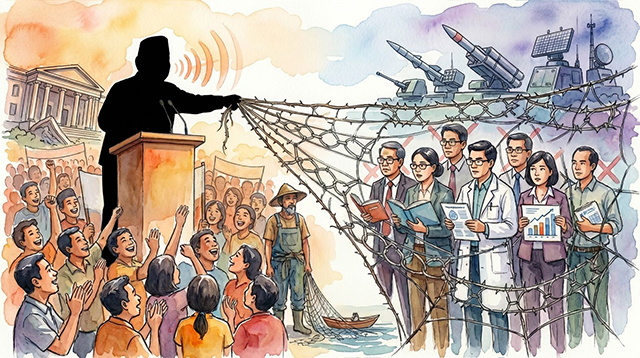
 Generate by AI


Penulis

Data from the LAB 45 Weapon Systems Database (defensedatabase.lab45.id) reveal a finding that Indonesia’s diversification debate has largely missed: within the Perisai Trisula Nusantara (PTN) framework, Land Shield has reached roughly 72% of its fulfilment target, while Sea Shield sits at only 22% and Networked C4ISR at 38%, with no additional systems currently on order. This is not a marginal shortfall: it is close to a three-to-one gap between the shield component facing the least strategic pressure and the one facing the most.
Challenges such as maritime insecurity, grey-zone threats, and increasing rivalry among major powers require a clear maritime and air defence strategy focused on surveillance, cooperation, and long-term deterrence. However, Indonesia’s procurement decisions remain fragmented, rely on many different suppliers, and are often not aligned with the country’s own strategic plans. Addressing these challenges requires a more disciplined procurement strategy that assigns clear roles to defence partners, prioritizes critical capabilities and sustainment, and strengthens Indonesia’s domestic defence industry.
International pressure alone does not explain how Indonesia responds to it. However, domestic political and institutional factors shape that just as much. In Indonesia, diversification has moved beyond the goal of strategic autonomy and has instead created a procurement system that weakens the coherence of its defence deterrence strategy.
The Threat is Read Correctly
Indonesia’s external security environment generates clear strategic incentives for maritime and air-domain modernisation. As the world’s largest archipelagic state, covering more than 5,000 kilometres across important sea trade routes, Indonesia faces security challenges that make maritime surveillance, flexible defence systems, and integrated command-and-control more important than simply increasing the number of military platforms. The country's vast maritime domain also remains highly vulnerable to illegal, unreported, and unregulated (IUU) fishing, maritime piracy, smuggling, trafficking, and other forms of transnational organised crime, creating persistent demands for continuous domain awareness and rapid-response capabilities across dispersed territorial waters.
Ongoing grey-zone activities by China in the North Natuna Sea have strengthened this concern. Although Jakarta avoids formally identifying Beijing as an adversary, Chinese coast guard operations, maritime militia activities, and overlapping territorial claims have gradually encouraged Indonesia to adopt a defence strategy focused on denial rather than direct naval competition (Basundoro and Yakti, 2025). Indonesia does not have the financial resources or strategic need to compete directly with a stronger maritime power through equal naval expansion. Instead, a more realistic strategy is asymmetric balancing through better maritime surveillance, anti-access systems, distributed missile capabilities, and resilient intelligence and reconnaissance systems.
Indonesia’s own strategic planning documents already acknowledge this need. The Archipelagic Trident Shield (Perisai Trisula Nusantara, PTN) shows that Indonesian planners understand the type of defence structure needed for a modern archipelagic state. Therefore, the main issue is not a misunderstanding of strategy, but problems in implementation.
The imbalance is clearest in the history of the Minimum Essential Force (MEF) program. Although Indonesia faced similar strategic pressures throughout all three MEF phases, it repeatedly failed to achieve its modernization targets. MEF Phase I achieved only 54.57% of its target, Phase II 63.19%, and Phase III 65.49%. The last phase measured against the adjusted target of 79% target, rather than the original 100% target stipulated in the RPJMN 2020–2024 and other public planning documents. This repeated failure suggests that the main problem is not changing threat perceptions, but ongoing domestic problems in connecting strategic planning with effective procurement implementation.
Figure 1. MEF Phase Achievement

Indonesia’s defence institutions have generally understood the strategic environment correctly. The PTN framework shows a practical grasp of Indonesia's geographic and strategic conditions. The question is why procurement outcomes continue to fall short of the defence structure the threat environment demands.
A Domestic Filtering Problem
The gap between Indonesia’s strategic needs and its procurement results is domestic, not strategic. External threats alone do not automatically translate into effective procurement. Instead, leadership preferences, institutional competition, financial capacity, and civil-military relations influence how states funds which threats. Indonesia’s procurement pattern shows these domestic factors pulling different parts of the military structure in different directions: some over-resourced, some under-resourced, regardless of where the actual threat sits.
Figure 2. Critical Gaps Between PTN and Current Inventory
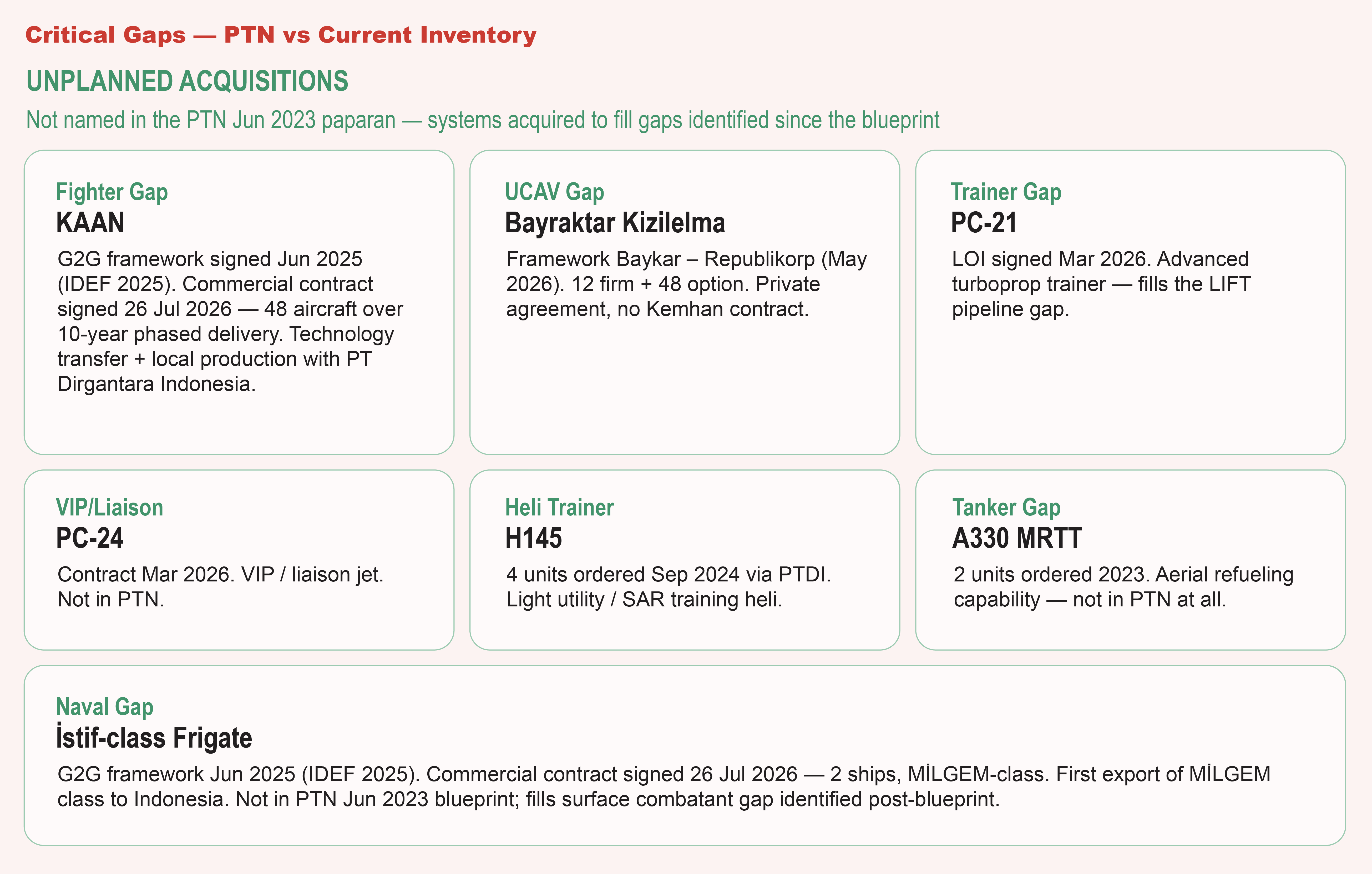
Source: LAB 45 Weapon Systems Database (defensedatabase.lab45.id).
First, leadership ideology and procurement preference. Although the MEF roadmap envisioned South Korea as Indonesia's principal long-term strategic partner for fighter modernisation through the KF-21 program, this trajectory began to shift during Prabowo Subianto's tenure as Minister of Defence in MEF Phase III. Rather than consolidating the existing partnership, Indonesia progressively diversified its fighter procurement to France (Rafale), Turkey (KAAN), and reportedly China (J-10), a pattern that has continued under the subsequent PTN framework.
While supplier diversification can enhance strategic flexibility, the resulting procurement portfolio reveals a mismatch between Indonesia's capability priorities and acquisition choices. The PTN identifies maritime surveillance and integrated C4ISR as the country's most pressing capability gaps, yet procurement has simultaneously expanded the fighter armada beyond the original MEF plan. The acquisition of 48 KAAN fighters despite existing commitments to the KF-21 and Rafale programs illustrates how leadership preference for high-profile combat platforms has, at times, taken precedence over institutional planning and the more urgent requirements for maritime surveillance, ISR integration, logistics, and sustainment.
Second, domestic factor reflected in competition between military institutions and their bargaining power. Indonesia has continued expanding its territorial army forces even though the main strategic focus has shifted toward maritime and air defence. By 2026, the TNI planned to expand military command (Komando Daerah Militer) structures and create new territorial development battalions (Batalion Teritorial Pembangunan), which require large amounts of funding for personnel-based land-force infrastructure (Supriatma, 2025).
This imbalance is clearly visible in the PTN framework. The asymmetry is best read against the aggregate diversification story that dominates existing commentary. Laksmana’s account of Indonesia’s “retail approach” treats the more-than-30-country supplier base as a straightforward resilience-versus-integration trade-off, without asking which part of the force structure that resilience actually reaches (Laksmana, 2023). Gindarsah’s more recent account of Prabowo’s shift toward “heavy hedging” updates the same aggregate picture. Seven new supplier nations for major arms contracts between late 2024 and 2025 alone, layered onto a sharp rise in defence agreements and joint exercises. However, this also measures diversification by counting partners rather than capability tiers (Gindarsah, 2026).
What neither account quantifies is exactly what the PTN data shows: the same hedging behaviour that looks resilient by supplier count is, tier by tier, concentrated overwhelmingly in land forces, while the maritime and C4ISR tiers facing the greatest strategic pressure remain the thinnest. This is not a threat-driven outcome; it is a domestic one. The Indonesian Army’s strong influence within the defence bureaucracy is therefore an important domestic factor that cannot be fully explained through structural analysis alone. Indonesia is under-investing in maritime and surveillance capabilities while continuing to spend heavily on territorial land-force infrastructure, even though its strategic importance has decreased compared to the maritime domain.
Third, state extractive capacity and fiscal competition. Indonesia’s modernization efforts face serious financial pressure because the government is also expanding welfare programs and broader macroeconomic pressures. The Makan Bergizi Gratis (MBG) program alone is expected to cost around Rp 171 trillion in 2025 and may exceed above Rp 300 trillion annually (Wangge and Idris, 2025). This pressure is further compounded by other politically prioritised expenditures, including the Red and White Village Cooperatives programme and higher energy subsidies, contributing to a fiscal deficit of 2.92% of GDP in 2025, while the rupiah depreciated by 14.3% since October 2024 (Habir and Negara, 2025). Together with US$37.1 billion in combined foreign and domestic capital outflows during 2025–2026, these fiscal and macroeconomic pressures have constrained the state's extractive capacity, forcing defence modernisation to compete within an increasingly limited fiscal envelope despite rising strategic demands.
However, these pressures describe the current fiscal environment rather than explain the persistent implementation gap across MEF Phases I–III, which emerged well before these conditions and therefore requires a different explanation. MEF's underachievement instead reflects a recurring structural weakness rather than a series of isolated shocks. Although the government attributed Phase III's shortfall to budget reallocations during the COVID-19 pandemic (Azzahra, 2024), Phases I and II had already failed to meet their targets before the pandemic. More importantly, if an extraordinary emergency was sufficient to derail modernization once, then predictable fiscal competition from welfare expansion and subsidy programmes should be incorporated into defence planning from the outset rather than invoked after implementation falls short.
Historically, Indonesia’s defence budget has been dominated by personnel and operational expenditure, which consistently absorbed more than 55% of total spending, leaving only a limited share for modernization, research, and investment. However, recent budget trends indicate a gradual improvement, with modernization expenditure beginning to receive a larger proportion of defence allocations (Laboratorium Indonesia 2045, 2026: 358). Sustaining this trend will require a larger and more strategically focused defence budget that protects modernization funding while ensuring adequate resources for readiness, sustainment, and personnel.
External pressure alone cannot drive military modernization if the state lacks the fiscal capacity to fund both welfare expansion and defence reform simultaneously. Countries with stronger economies may manage both priorities, but Indonesia faces difficulty balancing them. As a result, defence modernization is shaped more by domestic economic and political pressures than by external security concerns. Because of this, Indonesia’s military procurement remains uneven. Indonesia performs better when military purchases follow an asymmetric defence strategy. However, when procurement is influenced by institutional competition, leadership preferences, and budget fragmentation, modernization no longer matches strategic needs.
Diversification as Rational Hedging
At first, the solution seems simple: reduce the number of defence suppliers, focus procurement on fewer partners, standardize logistics and maintenance systems, and invest more in priority defence sectors. In practice, this would improve cooperation between military systems, lower maintenance difficulties, and strengthen long-term operational support (Pratama, 2026). However, this solution conflicts with Indonesia’s long-standing policy of hedging and non-alignment.
Indonesia’s “Free and Active” (Bebas Aktif) foreign policy rejects heavy dependence on any single major power. As a result, supplier diversification is not only an inefficient procurement practice, but also a way for Indonesia to maintain strategic autonomy. Supplier diversification is not simply inefficient procurement, it is also how Indonesia keeps every major power invested enough to stay engaged, but never dominant enough to dictate terms. In Indonesia, this approach is clearly reflected in its defence equipment and procurement system.
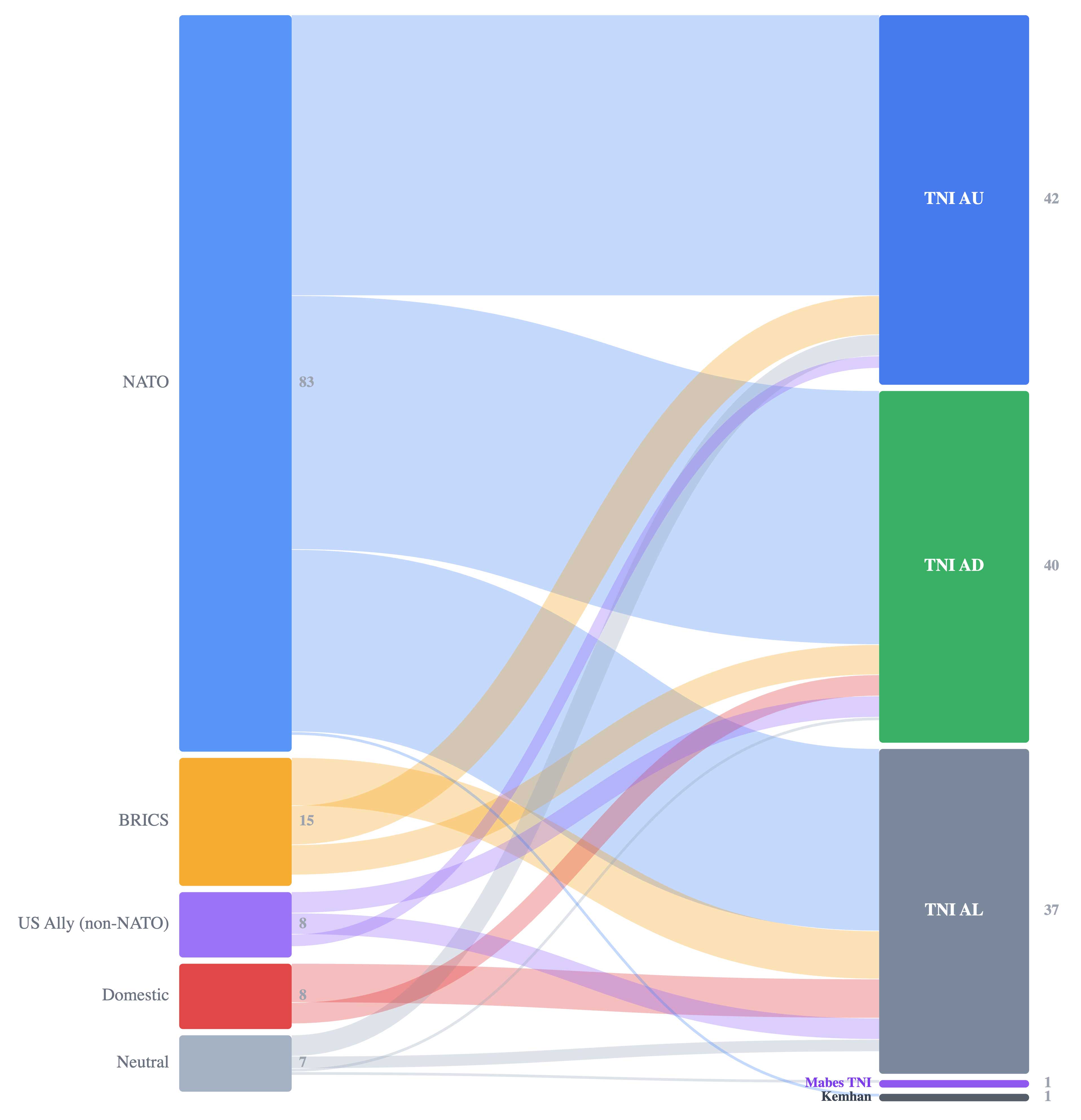
The LAB 45 Weapon Systems Database supplier chart demonstrates this pattern clearly. Indonesia maintains procurement relationships with 19 suppliers: the United States, Russia, France, Turkey, South Korea, Italy, Switzerland, and India, among others. The resulting inventory appears operationally fragmented because it is not organized solely around capability optimization. It is simultaneously organized around diplomatic diversification and strategic autonomy preservation.
Figure 3. Indonesia Weapon System Supplier
This diversification logic is historically rational. Indonesia’s experience with the United States arms embargo between 1999 and 2005 demonstrated how supplier dependency could become a mechanism of political coercion (NBC News, 2005). More recently, CAATSA-related pressure effectively collapsed the Su-35 acquisition process with Russia despite Jakarta’s operational preference for the platform (Basundoro, 2025). Western systems also frequently carry political conditions related to end-use restrictions, interoperability requirements, or technology transfer limitations.
Diversification therefore emerges as a rational response to demonstrated strategic vulnerability. The problem is not hedging itself but the absence of functional discipline within hedging behaviour. Indonesia’s supplier relationships frequently overlap within the same capability tier rather than complementing one another across distinct architectural layers.
The same logic that keeps Indonesia diplomatically non-aligned should apply to procurement. No single partner should dominate a critical capability area, thereby reducing vulnerability to political pressure, embargoes, or supply disruptions. Consequently, procurement diversification should be understood not simply as a bureaucratic outcome, but as part of Indonesia's broader strategy for managing great-power competition. In this sense, the right unit of analysis is the supplier relationship within each capability tier, not the individual platform or countries.
The LAB 45 Weapon Systems Database clearly shows the gap between Indonesia’s strategic plans and actual procurement. Although defence planners have identified the military structure Indonesia needs, procurement still fails to invest enough in the areas most important for modern deterrence across an archipelagic state.
The by-category MEF data illustrate this same pattern in finer detail: Naval aviation has reached only 14% of its MEF target, submarines 40%, and artillery and missile systems 14%, all of which are considered major shortages. However, Coastal and Ship Missiles, which support a distributed denial strategy, have exceeded MEF targets.
Figure 4. MEF Target Compared to Reality
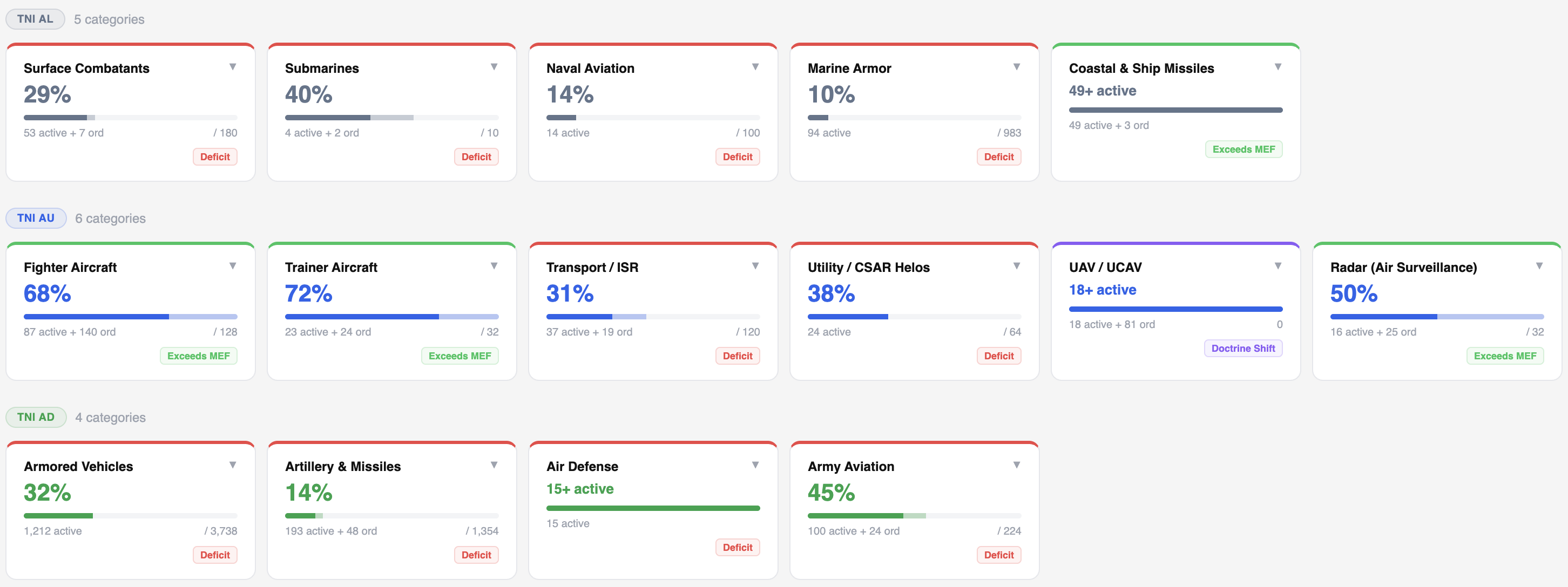
Source: LAB 45 Weapon Systems Database (defensedatabase.lab45.id).
The clearest example is the gap in surveillance and ISR systems. Networked C4ISR capability has reached only 38% of its target, and no additional systems are currently being ordered. However, this area is foundational: it acts as the “central nervous system” of a distributed denial strategy. Maritime surveillance, targeting systems, data sharing, and battle management are all necessary to make missile systems, fighter jets, and naval forces operate effectively together.
Figure 5. Perisai Trisula Nusantara (Trident Shield of the Archipelago)

The AEW&C program illustrates this contradiction sharply. Although around US$800 million has been prepared for procurement planning, Indonesia still has not chosen the platform, and the wider Networked Shield system also lacks active procurement plans (Rizkia, 2024). Strategic pressures show that ISR integration should be a priority, but procurement decisions still focus more on high-profile prestige platforms.
The gap in maritime denial is also serious. Sea Shield has achieved only 24% of its target, even though Indonesia depends heavily on maritime control and denial. However, Coastal and Ship Missiles, the only category that exceeds MEF targets, strongly supports asymmetric denial strategy. Indonesia performs better when procurement follows distributed denial principles rather than prestige-based acquisition. The issue is not that asymmetric denial cannot work in Indonesia, but that successful examples remain exceptions instead of becoming the main basis of modernization strategy.
Indonesia’s domestic munitions industry provides another important example. Indigenous loitering munition projects such as KI50 and Rajata are more sustainable forms of asymmetric capability development because they minimize foreign dependency, reduce embargo vulnerability, and strengthen local industrial knowledge (Koran Jakarta, 2026; Jajuli, 2022). These systems also suit Indonesia’s geography better than expensive prestige platforms that require high maintenance. However, neither project has become a major PTN priority despite matching distributed denial logic well.
The wider issue extends beyond platform diversification to long-term sustainment. Indonesia’s expanding military inventory increasingly looks capable on paper but not yet matched by adequate investment in ammunition stockpiles, maintenance infrastructure, repair facilities, and trained technical personnel. This condition might limit operational readiness despite growing platform numbers and increase the risk that readiness will deteriorate during prolonged contingency operations or crises.
Toward Disciplined Hedging
The policy implication is not that Indonesia should abandon diversification altogether. Hedging remains a rational strategy because Indonesia has experienced embargoes in the past and wants to maintain strategic autonomy in an increasingly divided Indo-Pacific region. A more realistic solution is disciplined hedging: each supplier assigned a distinct functional role within the PTN architecture.
Future procurement should therefore prioritize diversification across capability domains rather than simply across suppliers, shifting toward a more balanced force structure that integrates maritime, air, and land-based capabilities with enabling technologies such as C4ISR, integrated air and missile defence, maritime domain awareness, radar, electronic warfare, counter-drone systems, and other asymmetric capabilities required for a distributed-denial strategy against contemporary threats.
At the same time, indigenous asymmetric-denial capabilities, particularly domestically developed loitering munitions and related systems, should be formally integrated into the PTN with dedicated funding to reduce dependence on foreign suppliers, strengthen resilience against future embargoes, and enhance Indonesia's long-term strategic autonomy.
Instead of choosing suppliers mainly because of attractive platforms, Indonesia should give each defence partner a specific role within the PTN framework. France, for example, could focus on precision-strike systems and submarine co-production through Rafale support, SCALP missiles, and Scorpène submarine collaboration with PT PAL. Turkey could focus on drones, missile technology, and asymmetric denial technologies rather than prestige fighter acquisitions. South Korea could concentrate on ammunition and rocket co-development through LIG and surveillance integration rather than solely the KF-21 program.
Cooperation with the United States should prioritize ISR interoperability, intelligence sharing, and maritime domain awareness through programs such as Super Garuda Shield rather than relying heavily on major arms purchases. Japan could specialize in anti-submarine warfare and maritime industrial cooperation, especially through Mogami-class frigates. Russia, meanwhile, may require a gradual reduction in defence dependence, or focus on sustainment and stockpile consolidation, before the partnership becomes politically untenable.
India's recent growing role demonstrates how a function-based procurement strategy can be operationalized. The July 2026 BrahMos agreement assigns India a specific role in providing land based coastal defence missiles for Indonesia's strategic maritime chokepoints, while the accompanying agreement on Astra air-to-air missiles diversifies armament sources for the Indonesian Air Force's Russian-origin Su-27 and Su-30 fleet, reducing dependence on a single supplier. As both projects are financed through a foreign commercial loan approved in September 2025, they reinforce an existing procurement trajectory and illustrate how future cooperation should assign suppliers clear functional roles that address specific capability gaps rather than broader diplomatic relationships.
However, disciplined hedging requires more than assigning suppliers distinct functions. It also depends on whether procurements align with Indonesia's operational requirements, remain consistent with fiscal capacity, and is supported by long-term cooperation that reinforces specialised roles instead of reverting to fragmented, platform-driven acquisitions.
The goal is to organize suppliers according to strategic function.
Ultimately, international pressures will continue to shape Indonesia’s defence policy regardless of domestic political preferences. Indonesia can either align its procurement decisions with the strategic logic already present in its defence planning or continue building a fragmented military inventory that weakens overall deterrence. Disciplined hedging offers a way to reconcile supplier diversification with strategic coherence by ensuring that procurement decisions serve clearly defined capability requirements rather than short-term political or commercial opportunities.
Reference List
Azzahra, T.A. (2024). "Jubir Prabowo Ungkap Alasan MEF Tak Capai Target di 2024." Detik, 5 January 2024.
Basundoro, A.F. (2025). “Indonesia's defence modernisation needs procurement discipline.” East Asia Forum, 25 September 2025.
Basundoro, A.F. & Yakti, P.D. (2025). “Indonesia's South China Sea policy needs more than legalism.” East Asia Forum, 13 May 2025.
Jajuli, J. (2022). “Rajata DAHANA Siap Bersaing dengan Kamikaze Drone Dunia.” PT Dahana, 16 November 2022.
Gindarsah, I. (2026). “Indonesia's Heavy Strategic Hedging amid a Polarised World.” RSIS IDSS Paper, IP26068, 22 May 2026.
Habir, M. & Negara, S.D. (2025). “Prabowo’s economic agenda faces a fiscal stress test.” East Asia Forum, 19 July 2025.
Koran Jakarta (2026). “Mengenal Drone KI50 Milik Indonesia. Spesifikasi Teknis dan Simulasi Perang.” 25 April 2026.
Kuik, C.C. (2008). “The Essence of Hedging: Malaysia and Singapore's Response to a Rising China.” Contemporary Southeast Asia 30(2): 159–185.
Kuik, C.C. (2021). “Getting Hedging Right: A Small-State Perspective.” China International Strategy Review 3(2): 300–315.
Laboratorium Indonesia 2045 (2026). “Jam Pasir Indonesia: Menakar Masa Depan Indonesia dari Butir Kuasa dan Ketimpangan.” Kompas, p. 358.
Laksmana, E.A. (2023). “What Indonesia's Retail Approach to Defence Modernisation Means.” IISS Military Balance Blog, 18 September 2023.
Malufti, F. (2026). "Indonesia Signs BrahMos Missile Deal with India." Naval News, 8 July 2026.
NBC News (2005). “U.S. Lifts Arms Embargo Against Indonesia.” 23 November 2005.
Pratama, S.J. (2026). “Indonesia's Arms Diversification Is Inevitable, But It Must Be Prudent.” Foreign Policy Talks, 2 Januari 2026.
Rahmat, R. (2026). "India, Indonesia agree BrahMos, air-to-air missile deals." Janes, 8 July 2026.
Rose, G. (1998). “Neoclassical Realism and Theories of Foreign Policy.” World Politics 51(1): 144–172.
Supriatma, M. (2025). “Expansion of the Indonesian Army: A Creeping Dual Function?” Fulcrum, 21 January 2025.
Wangge, I. & Idris, I. (2025). “Indonesia's Free Meals Program Under Fire for Safety Failures and Governance Breakdown.” The Diplomat, 20 October 2025.
Rizkia, Z. (2024). “Pesawat AEW&C Batal Indonesia Beli, Duit Utangan dari Luar Negeri Pilih NKRI Belanjakan Buat Armada Ini.” Zona Jakarta, 27 Februari 2024.