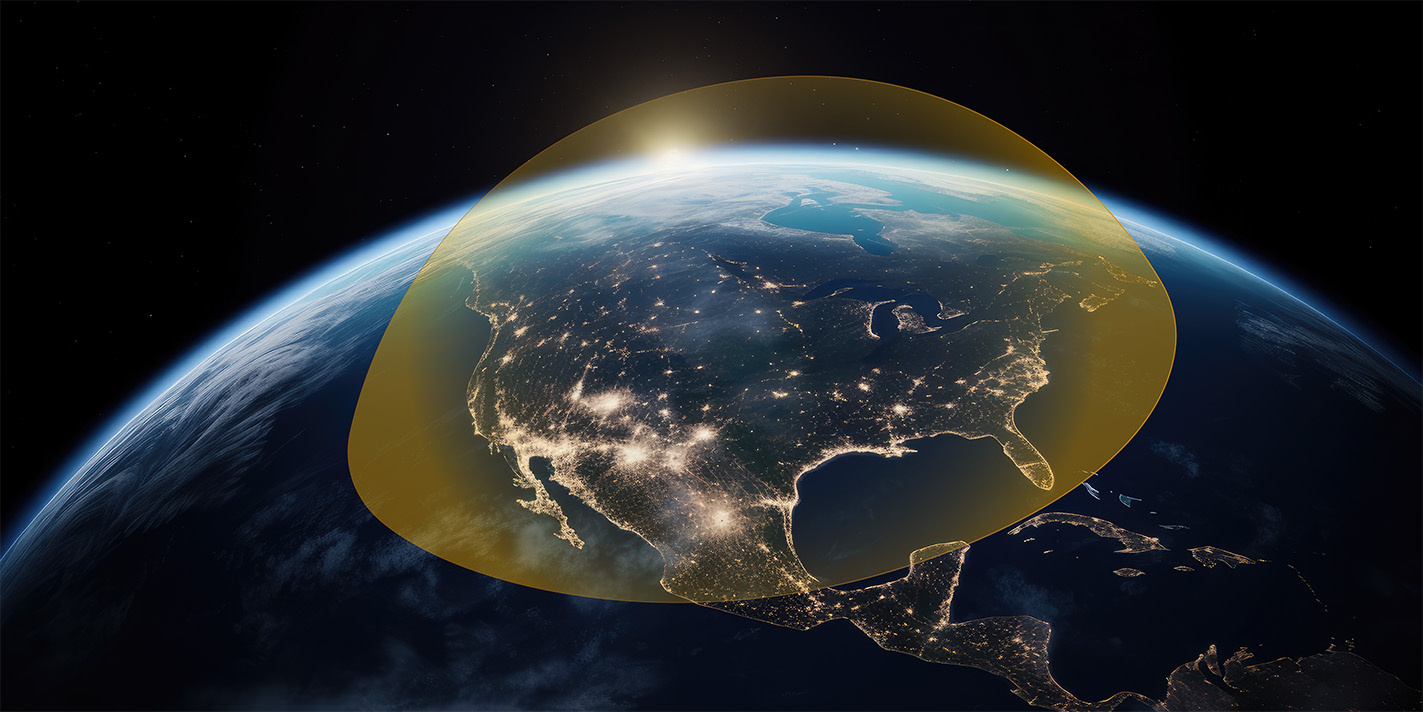
 The United Shield of Golden Dome


Penulis

A vast, radiant shield spans America’s skies, designed to intercept missiles in a futuristic global conflict. This is the Golden Dome, a $175 billion missile defense initiative unveiled by President Trump in May 2025 to protect the U.S. from threats posed by China, Russia, North Korea, and Iran. Trump described a constellation of satellites and ground-based systems like THAAD and Aegis, promising an impregnable defense by 2029. Ambitious and polarizing, the plan evokes a fortress rising from the Pentagon’s core. Yet, its bold vision carries risks, potentially undermining America’s global leadership and igniting an arms race. In a world driven by power and survival, a unilateral approach could alarm rivals, heightening instability. However, restructured as a collaborative, multi-purpose endeavor, it could cement the U.S. as a global leader. By examining Cold War strategies, particularly the deft diplomacy of the arms race and the brilliance of Reagan’s Star Wars, we can see where the Dome aligns, where it falters, and how it might triumph.
Lessons from Cold War Leadership
The Cold War, spanning the late 1940s to the early 1990s, offers a model of global leadership through cooperation. The Marshall Plan transformed Europe’s war-torn ruins into thriving economies, while NATO unified allies against the Soviet Union. These initiatives shared prosperity and security, fostering trust and establishing American dominance. In contrast, the Golden Dome appears as a solitary stronghold, prioritizing U.S. interests. Its $175 billion cost, with trillions more projected over decades, threatens to divert resources from critical issues like climate change or healthcare. While Canada may participate, the project’s “America First” stance lacks the collaborative spirit of NATO or the Marshall Plan. This insularity risks isolating the U.S., a misstep in a world where alliances amplify influence. The Dome’s unilateral focus could hinder the partnerships that defined Cold War success, setting the stage for diplomatic and strategic challenges.
The Trust Deficit
Compounding these challenges is a lack of transparency, which erodes credibility. Critics, including Senator Jack Reed, have branded the Dome a “slush fund”, citing opaque spending linked to Trump’s allies. Such secrecy undermines the trust essential for leadership, casting the project as a display of bravado rather than a strategic necessity. Furthermore, its focus on job creation in select U.S. states seems tailored to domestic politics rather than global cooperation, unlike the Cold War’s Apollo program, which captivated the world with shared scientific achievements. This inward focus could strain alliances and complicate negotiations with adversaries like China and Russia. The Cold War demonstrated the power of openness and unity in rallying global support, a lesson the Dome’s current approach overlooks, risking further alienation of key partners.
A Shield or a Sword
The Dome’s strategic implications deepen these concerns, as a defensive shield to one nation may appear as an offensive threat to another. Marketed as protection against missiles from hostile states, its advanced space-based technology and expansive scope suggest the capacity to neutralize rivals’ arsenals, granting the U.S. a strategic advantage. While intended to deter attacks, this capability risks signaling preparations for a first strike. China has criticized it as “weaponizing space” and Russia views it as a direct challenge. Neutralizing even a small number of missiles would require thousands of interceptors, a logistical challenge for a nation as vast as the U.S. If adversaries perceive their defenses as compromised, they may escalate their arsenals, triggering a cycle of fear and armament. The Dome’s dual nature—defensive yet potentially offensive—mirrors Cold War tensions, where perception shaped reality.
The Obsolescence of Current Defenses
Adding to this tension, the Dome’s deployment could render existing missile defense systems obsolete, reshaping global security dynamics. The U.S. relies on a layered approach: Ground-Based Midcourse Defense (GMD) in Alaska and California targets ICBMs mid-flight but is limited to rogue threats like North Korea and struggles with decoys. Aegis, deployed on ships and land, uses SM-3 and SM-6 missiles to counter short- to medium-range threats, proving effective in 2024 against Iran’s assault on Israel, though it requires clear radar lines. THAAD intercepts missiles in their final descent, operating in South Korea and Guam, but its range is narrow. Patriot PAC-3 excels against short-range threats, as seen in Ukraine against Russian hypersonics, yet its coverage is localized. Israel’s Iron Dome neutralizes short-range rockets with a 90% success rate, while Arrow 3 intercepts missiles in space, though both are regionally focused. Russia’s S-400 and China’s HQ-19 are formidable but ground-based, lacking the Dome’s orbital reach. The Dome’s integrated satellite network and vast interceptor array promise to cover all ranges and angles, potentially sidelining GMD’s fixed sites, Aegis’ ship-based constraints, THAAD’s limited scope, and even Iron Dome’s localized role. Social media posts speculate the Dome could redefine defense, but critics warn it may marginalize allies’ systems, like India’s S-400 or NATO’s Aegis, fostering dependence on U.S. technology. This shift could disrupt established defense networks, amplifying the need for careful diplomacy.
Cold War Diplomacy and Star Wars Brilliance
The Cold War navigated similar challenges with a blend of bold defense and masterful diplomacy. The U.S. relied on mutual assured destruction (MAD), ensuring a single nuclear strike by either the U.S. or the Soviets would provoke mutual annihilation. This reciprocal vulnerability transformed nuclear weapons into tools of peace, designed to deter rather than destroy, maintaining a tense but stable equilibrium. Reagan’s 1983 Strategic Defense Initiative (SDI), or Star Wars, disrupted this balance. Presented as a defensive shield, it alarmed the Soviets, who feared it enabled a U.S. first strike by neutralizing their retaliation, threatening MAD’s foundation. Yet, Star Wars was a stroke of strategic genius. Though the technology was underdeveloped, its bold promise overwhelmed the Soviet Union’s faltering economy. The U.S. invested heavily, showcasing its industrial prowess, while the Soviets, unable to match the spending, diverted critical resources. By the late 1980s, the USSR was crumbling—Star Wars’ psychological and economic pressure, combined with Gorbachev’s reforms, accelerated its 1991 collapse, securing a U.S. victory without direct conflict. The Dome shares this disruptive potential but lacks the diplomatic counterbalance that made Star Wars effective.
The Art of Arms Race Diplomacy
Cold War diplomacy tempered such risks, offering lessons for the Dome’s challenges. The 1972 Anti-Ballistic Missile (ABM) Treaty limited defenses to preserve MAD’s shared vulnerability, signaling mutual trust. The Strategic Arms Limitation Talks (SALT), launched in the late 1960s, saw intense negotiations in Geneva, capping missile and warhead arsenals to slow the arms race. During the 1962 Cuban Missile Crisis, secret communications between Kennedy and Khrushchev, paired with public restraint, averted disaster. The U.S. and Soviets embraced “trust but verify”, using inspections, satellite monitoring, and transparent data to maintain stability. Reagan’s Star Wars pushed boundaries, but his summits with Gorbachev, discussing a nuclear-free world, kept diplomacy alive, balancing ambition with reassurance. The Dome, by contrast, operates in isolation, its secrecy—marked by unclear budgets and suspected cronyism—fueling distrust. Without dialogue to affirm shared vulnerability, it risks provoking China and Russia to bolster their arsenals, echoing Cold War escalations without the diplomatic safety net.
The Power of Alliances
Collaboration, a Cold War strength, is another area where the Dome falls short. NATO’s collective defense and multinational projects like the Aegis system distributed costs and responsibilities. Even Star Wars involved consultations with allies like the UK. The Dome’s U.S.-centric approach could alienate partners expecting cooperation, as seen in NATO’s Aegis Ashore, and its potential to obsolete allied systems, like Aegis or Iron Dome, may strain partnerships further. The Cold War showed that alliances amplify power, a principle the Dome risks ignoring in its solitary pursuit.
Despite these risks, the Dome holds transformative potential if guided by Cold War lessons. By inviting allies like Japan, South Korea, and India to co-develop and fund the project, it could mirror NATO’s collaborative model, ensuring allied systems remain relevant. The Cold War’s GPS, initially military, became a global utility; similarly, the Dome’s satellites could track missiles while monitoring climate threats—wildfires, storms, pollution—and delivering internet to remote regions, akin to SpaceX’s Starlink. Such dual-use benefits would generate jobs, data, and connectivity, echoing Apollo’s universal legacy. Transparency is non-negotiable to build trust. The Pentagon must openly detail costs, timelines, and partnerships, avoiding favoritism toward firms like Lockheed Martin. Cold War budgets were transparent, fostering confidence.
A Shield for All
Diplomatically, SALT-style negotiations could propose space-use norms or defense transparency, with summits in cities like Singapore or Vienna to establish satellite inspections and clear boundaries, reflecting the ABM Treaty’s commitment to shared vulnerability and nuclear deterrence. Economically, a collaborative Dome could drive technological innovation across Europe and Asia, as Cold War investments spurred the internet’s creation. This approach transforms the Dome from a unilateral gamble into a platform for leadership in defense, climate, and technology. The Golden Dome, as it stands, courts peril with its insular, opaque, and provocative design, threatening to render systems like GMD, Aegis, and Iron Dome obsolete while destabilizing global security.
In a world defined by power and survival, the Dome overlooks the necessity of trust and balance. Yet, by embracing Cold War wisdom—alliances, multi-purpose technology, and diplomacy inspired by ABM, SALT, and Reagan’s Star Wars triumph—the Dome could become a beacon of U.S. leadership. A transparent, collaborative, and versatile shield would reaffirm America’s role as a global steward, fostering a safer, stronger world, much like the Cold War’s boldest achievements.