 Indonesia’s Shifting Foreign Policy on Palestine and Israel


Penulis

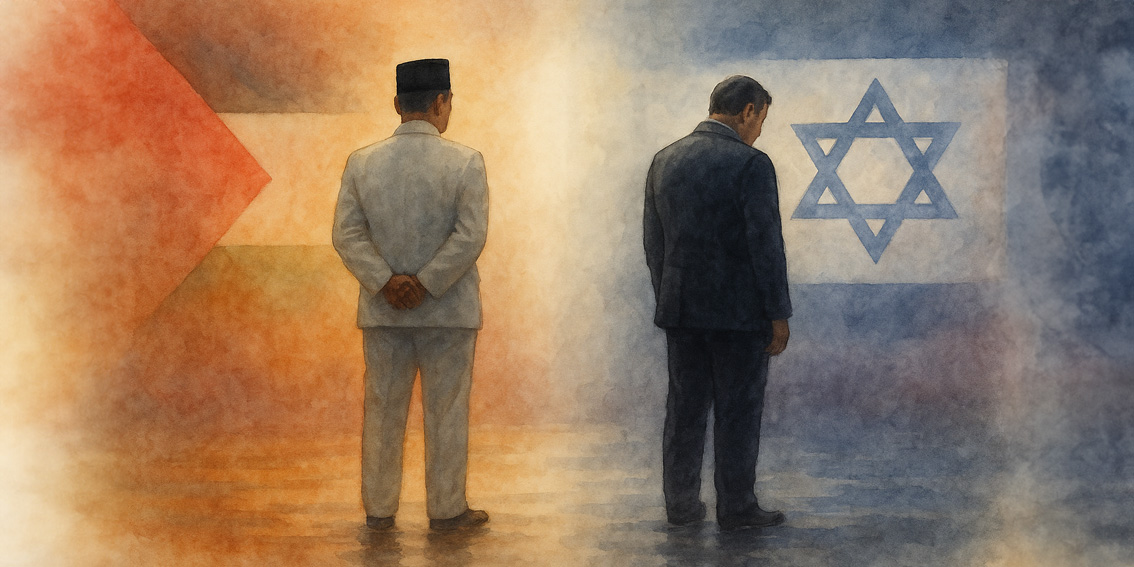
For decades, Indonesia, the world’s largest Muslim-majority nation, has been a steadfast supporter of Palestinian independence. This position is deeply rooted in its anti-colonial ethos and historical non-recognition of Israel. However, at the United Nations General Assembly on September 23, 2025, President Prabowo Subianto signaled a significant policy shift. He pledged to recognize Israel and ensure its security on the condition that it acknowledges Palestinian statehood. In a speech that condemned the violence in Gaza as a humanitarian catastrophe and offered peacekeepers, Prabowo’s use of the word “Shalom” marked a departure from the era of solidarity with Palestine established by Indonesia’s first president, Sukarno. This move toward conditional diplomacy has prompted significant domestic debate and international interest in Indonesia’s evolving role in the Israeli-Palestinian conflict.
This moment encapsulates the evolution of Indonesia’s foreign policy, from the strong anti-imperialist stance of founding father Sukarno to the pragmatic realism of Prabowo. While Indonesia’s position has long been one of unwavering solidarity with the Palestinians, shifting global dynamics have compelled Jakarta to balance domestic sentiment with international ambitions. Prabowo’s speech, which was commended by Israeli Prime Minister Benjamin Netanyahu, has led to a debate on whether the move represents a departure from Sukarno’s foundational principles or a pragmatic step toward conflict resolution. This position not merely as an observer but as a potential mediator in one of the world’s most intractable conflicts.
Prabowo’s diplomatic initiative coincides with a renewed push by U.S. President Donald Trump for a Gaza peace plan. Trump’s proposal, presented to leaders of several Arab and Muslim nations, including Indonesia, envisions an end to the war and the establishment of a new security framework for Gaza. This plan is tied to the expansion of the Abraham Accords, the 2020 normalization pacts between Israel and states such as the UAE and Bahrain. It presents several opportunities for Indonesia, including potential peacekeeping roles and membership in an expanded Accords network, which could yield economic and geopolitical benefits. However, pursuing these opportunities carries the risk of domestic backlash in a nation with deep-rooted pro-Palestinian sentiment.
Sukarno’s Era: Anti-Imperialism and Unwavering Solidarity with Palestine
Indonesia’s foundational stance on the Israeli-Palestinian conflict was forged under President Sukarno (1945-1967). He viewed the establishment of Israel in 1948 as a colonial imposition by Western powers, a perspective aligned with Indonesia’s constitutional mandate to oppose all forms of colonialism. This solidarity was reinforced by the support Indonesia received from Palestinian leaders like Grand Mufti Muhammad Amin al-Husseini during its own struggle for independence from Dutch rule. By 1953, Indonesia’s commitment was demonstrated through a $60,000 donation to Palestinian causes at the Islamic Congress in Jerusalem, where Sukarno referred to Arabs as “distant brothers”.
The 1955 Bandung Conference, which convened 29 Asian and African nations, cemented this anti-colonial position. Israel was excluded from the conference, while Palestinian delegates were invited. The final communiqué condemned the “tensions in the Middle East... caused by the situation in Palestine” and explicitly supported the rights of the Palestinian people, framing the issue as part of the broader global struggle against imperialism.
Central to the conference’s legacy were the Dasa Sila Bandung (Ten Principles), which promoted respect for national sovereignty, racial equality, and non-interference in the internal affairs of other countries. These principles provided a normative framework for supporting Palestinian self-determination and challenging colonial occupations. Sukarno’s opposition to Israel remained unwavering throughout his presidency. During the 1956 Suez Crisis, Indonesia supported Egypt; it later boycotted Israel in the 1957 World Cup qualifiers and expelled Israeli athletes from the 1962 Asian Games, leading to the creation of the alternative Games of the New Emerging Forces (GANEFO). Sukarno famously declared, “As long as Palestinian independence has not been handed over to the Palestinians, Indonesia will stand against Israeli colonialism.” This ideological position, supported by major Islamic organizations like Nahdlatul Ulama (NU) and Muhammadiyah, resonated domestically but limited Indonesia’s economic and political engagement with Western-aligned nations.
Post-Sukarno Transitions: Ambiguity and Continuity
Following Sukarno’s removal from power in 1967, President Suharto’s New Order (1967-1998) adopted a more ambiguous policy. While publicly maintaining pro-Palestinian rhetoric, the regime quietly pursued discreet ties with Israel, primarily for military and security purposes. This included Operation Alpha in the 1970s, through which Indonesia covertly acquired refurbished Israeli A-4 Skyhawk jets. Throughout the 1980s and 1990s, this pragmatic engagement expanded to include low-profile intelligence sharing and technical cooperation. A notable event occurred in 1993 when Suharto held a private meeting with Israeli Prime Minister Yitzhak Rabin in Jakarta to discuss potential normalization, contingent on the establishment of a Palestinian state. This balancing act allowed the New Order to maintain rhetorical support for the Palestine Liberation Organization (PLO), which it formally recognized in 1988, while pursuing strategic interests with Israel.
Post-1998 democratic leaders, including Megawati Sukarnoputri, Susilo Bambang Yudhoyono, and Joko Widodo, largely reverted to Sukarno’s foundational stance: no diplomatic recognition of Israel without a Palestinian state. As Sukarno’s daughter, President Megawati (2001-2004) was a vocal advocate for the Palestinian cause, particularly during the Second Intifada. This continuity was evident in subsequent administrations, which condemned Israeli military actions and provided humanitarian aid to Palestine. Public sentiment remained staunchly pro-Palestinian, culminating in Indonesia losing its hosting rights for the 2023 FIFA U-20 World Cup due to widespread political and public opposition to the Israeli team’s participation.
Prabowo’s Policy Shift: A Conditional Approach
President Prabowo’s 2025 UN speech marked a pragmatic evolution in Indonesia’s foreign policy. His offer to recognize Israel in exchange for Palestinian statehood aligns with Indonesia’s pursuit of OECD membership, which requires diplomatic relations with all member states, including Israel. The proposal to contribute up to 20,000 peacekeepers to Gaza reflects Indonesia’s aim to play a constructive role in global security.
The phrase “guarantee the safety and security of Israel” in his address prompted considerable domestic debate. Critics characterized it as a capitulation that prioritized Israeli security over Palestinian sovereignty, especially amid a conflict in Gaza that has resulted in over 60,000 deaths. Conversely, supporters argued the guarantee was conditional and essential for achieving a reciprocal peace, reflecting a pragmatic diplomatic approach similar to that of other Arab states. This linguistic flashpoint underscores the delicate balance Prabowo must strike between his international objectives and domestic political realities.
Prabowo’s proposal aligns with a U.S.-led Gaza peace plan advanced by President Donald Trump. The 20-point framework, developed with input from advisors such as Jared Kushner and former British Prime Minister Tony Blair.
The proposal outlines a multi-stage approach to de-escalate, stabilize, and rebuild Gaza. Its immediate provisions call for a ceasefire, the return of all Israeli hostages held by Hamas, and a proportional release of Palestinian prisoners by Israel. Upon agreement, aid flows would increase significantly to facilitate reconstruction. For governance and security, the plan requires the complete dismantlement of Hamas’s military capabilities and its exclusion from any future governing role. An Arab-led international stabilization force, coordinated by the U.S., would be deployed to secure borders, train a new Palestinian police force, and prevent rearmament. A transitional technocratic Palestinian committee would manage daily services until the Palestinian Authority is reformed.
Economically, it envisions substantial redevelopment funded primarily by Gulf states, including the creation of special economic zones to diversify and strengthen Gaza’s economy. In the long term, the plan commits Israel to refraining from permanent occupation or annexation of the West Bank and establishes a clear pathway toward Palestinian statehood, with future negotiations addressing core issues such as borders and Jerusalem.
On October 8, 2025, during indirect talks in Egypt’s Sharm el-Sheikh, Trump announced a significant development: Israel and Hamas had signed off on the first phase of the plan. In a post on Truth Social, Trump stated, “I am very proud to announce that Israel and Hamas have both signed off on the first Phase of our Peace Plan.” This initial phase focuses on implementing the ceasefire and initiating hostage and prisoner exchanges, marking a potential breakthrough after two years of conflict. The agreement has received tentative endorsements from Israeli Prime Minister Benjamin Netanyahu and some Arab leaders, while the Palestinian Authority has expressed cautious optimism about the statehood pathway, and Hamas has indicated conditional acceptance pending verification of terms.
On October 9, 2025, Israel and Hamas formally confirmed their agreement to the ceasefire and hostage release, mediated by the U.S., Egypt, and Qatar. This deal encompasses the release of all remaining 48 hostages—20 believed alive and 28 deceased—within 72 hours of Israeli approval, in exchange for Palestinian prisoners, with releases potentially beginning as early as October 13. Netanyahu described it as a “diplomatic success and a national and moral victory,” planning to convene his government for approval on October 10, while Hamas affirmed its commitment to national rights and self-determination. The UN Secretary-General urged full compliance and unimpeded humanitarian access, emphasizing an end to the suffering that has claimed over 67,000 lives since the October 7, 2023, attack.
Indonesia’s potential involvement in this evolving initiative offers opportunities to contribute to peacekeeping and reconstruction efforts, possibly under a UN mandate. Such engagement could enhance Indonesia’s global standing and unlock economic benefits, potentially through an expanded Abraham Accords framework. Participating without formal ties to Israel could allow Indonesia to maintain its non-aligned stance while supporting Palestinian state-building.
The rapid progression from Trump’s October 8 announcement to the formal agreement on October 9 highlights the momentum behind the U.S.-led framework, providing a timely opportunity for Prabowo’s conditional diplomacy. By pledging peacekeepers, Indonesia has positioned itself as a key non-Western partner in the stabilization force, potentially deploying its experienced Garuda contingent to secure borders and facilitate aid flows. This role aligns with the plan’s Arab-led force and leverages Indonesia’s history as a leading UN peacekeeping contributor, enabling it to advocate for Palestinian priorities such as statehood and East Jerusalem’s status amid regional divergences.
However, the agreement’s focus on the first phase—ceasefire and exchanges—leaves unresolved challenges, including Gaza’s post-war governance and Hamas’s disarmament, which could complicate Indonesia’s involvement. The deal’s humanitarian focus, particularly the release of hostages and increased aid, may mitigate domestic criticism from pro-Palestinian groups, but any perception of compromising Palestinian sovereignty could provoke backlash, especially if Gulf-funded reconstruction shapes the economic framework. Regionally, Indonesia’s participation could foster ties with Abraham Accords signatories while reinforcing solidarity with partners like Saudi Arabia and Turkey. To capitalize on this opportunity, Prabowo must prioritize UN-mandated engagement and transparent domestic consultations to ensure Indonesia’s role advances a two-state solution while aligning with its anti-colonial legacy and yielding pragmatic benefits in security cooperation and economic integration.
Indonesia’s evolving policy faces domestic and regional complexities. Public sentiment remains strongly pro-Palestinian, and any perceived shift toward Israel could spark criticism. Regionally, aligning with the U.S. plan requires navigating differing priorities, such as Saudi Arabia and Turkey’s emphasis on East Jerusalem as Palestine’s capital.
Prabowo’s administration must balance these dynamics with Indonesia’s international objectives. Transparent engagement with domestic stakeholders and ensuring Palestinian statehood remains central to any peace framework will be critical to maintaining public support. Leveraging its peacekeeping experience and non-aligned status, Indonesia has the potential to contribute meaningfully to conflict resolution while advancing its geopolitical and economic interests.
Conclusion
Indonesia’s foreign policy on the Israel-Palestine conflict has evolved from Sukarno’s ideological solidarity to Prabowo’s pragmatic diplomacy. Prabowo’s conditional approach to recognizing Israel aligns with the framework of the U.S.-led Gaza peace plan and signals a strategic shift toward proactive engagement. This alignment presents opportunities for Indonesia to enhance its international standing and secure economic benefits, but it also carries substantial domestic political risks.
The primary challenge for the Prabowo administration is to balance the deeply ingrained pro-Palestinian sentiment of its populace with the geopolitical and economic advantages of global cooperation. To succeed, the Indonesian government must engage with international partners to ensure that Palestinian statehood remains the central, actionable goal within any proposed peace framework. While Sukarno’s legacy was defined by ideological solidarity, Prabowo’s presidency will be judged by his ability to navigate this critical moment with a pragmatism that reinforces, rather than diminishes, Indonesia’s position in the struggle of vital interests between the US and Israel and the moral stance on Palestinian independence and sovereignty.