 To Kill the White Raven: A Realist Strategy to Avert Nuclear Catastrophe


Penulis

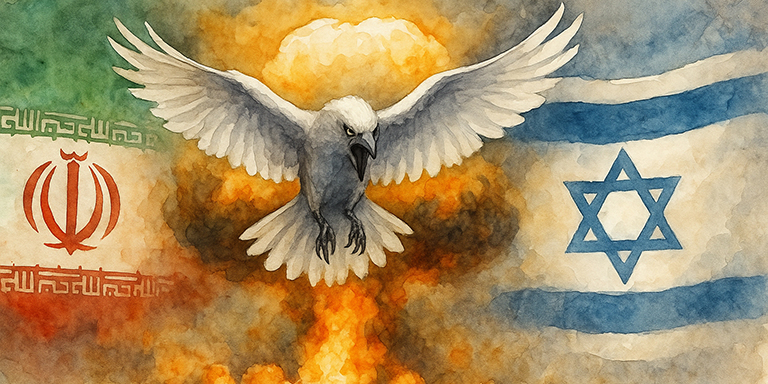
The Israel-Iran rivalry, a volatile fusion of strategic competition and ideological enmity, threatens to destabilize the Middle East and beyond. While a “black swan”—an unforeseen event disrupting systems like global markets—captures the attention of risk analysts, a “white raven” embodies a rarer, more perilous phenomenon. Rooted in folklore, the white raven heralds extraordinary upheaval, distinguished from the black swan by its capacity to ignite collective ideological or religious fervor, as seen in potential flashpoints like Jerusalem’s Al-Aqsa Mosque. This article envisions a white raven through a hypothetical worst-case scenario from June 13 to September 3, 2025, where Israel’s strike on Iran’s nuclear facilities triggers a cascade of escalations, culminating in Pakistan’s nuclear attack on Israel, driven by a declared intent to defend a fellow Muslim state. The scenario includes a “point of no return” and urges global powers to kill the white raven—neutralize this threat—through a realist strategy focused on mitigating great power rivalry. Though nuclear war is improbable, miscalculation risks demand urgent action. This piece outlines the white raven scenario, analyzes escalation drivers, and proposes pragmatic solutions.
The White Raven Scenario
In mythological traditions, a white raven signals cosmic disruption, its rare appearance defying expectations and rallying collective emotions. Unlike Nassim Taleb’s black swan, which denotes unpredictable systemic shocks (e.g., the 2008 financial crisis or the sudden oil price surges that could follow a Strait of Hormuz closure), the white raven carries an ideological charge, amplifying conflicts through cultural or religious symbolism, such as the Al-Aqsa Mosque’s sanctity. This dual nature of risk—systemic unpredictability and ideological fervor—is symbolically captured in the Lab45 logo, a conceptual emblem for this analysis. At the logo’s center, the black swan and white raven are depicted in a dynamic interplay: the black swan, with its dark plumage, represents the potential for economic collapse or energy crises, while the white raven, with its rare and striking white feathers, embodies the ideological escalation driven by religious or cultural triggers. Together, they form a circular design, suggesting that the Israel-Iran conflict merges these threats into a volatile synergy, necessitating a coordinated response to kill the white raven and mitigate its catastrophic potential.
Imagine the following fiction of white raven scenario:
On June 13, 2025, this white raven emerged as Israel launches “Operation Lion Rising,” a pre-emptive airstrike targeting Iran’s nuclear facilities in Natanz, Fordow, and Arak, and IRGC bases in Teheran, Tabriz, and Isfahan. Driven by intelligence of Iran’s 120 kilograms of 60% enriched uranium—sufficient for several bombs according to the International Atomic Energy Agency (IAEA) as of June 2025—the attack kills IRGC Commander Hossein Salami, six nuclear scientists, and approximately 300 personnel, severely damaging Iran’s nuclear infrastructure. The strike, intended as a systemic check on Iran’s nuclear ambitions, inadvertently ignites the white raven’s ideological fury, as Iran frames it as an assault on Islamic sovereignty.
Iran retaliates with “True Promise 3,” launching 300 ballistic missiles and drones at Tel Aviv, Haifa, and Dimona, overwhelming Israel’s Iron Dome and causing an estimated 150 civilian deaths. Hizbullah, despite its reduced capacity post-2024 clashes, fires 2,000 rockets from Lebanon, while Yemen’s Houthis target Israeli shipping in the Red Sea. Iraqi militias attack US bases in the Gulf, drawing American forces into the conflict. By July 15, 2025, Iran’s threats to close the Strait of Hormuz, through which 20% of global oil flows, spike oil prices by 35%, triggering inflation and economic unrest worldwide, aligning with the black swan’s systemic impact. Israel’s airstrikes in Syria and Lebanon kill 400 pro-Iran fighters, further escalating the regional conflict.
In August 2025, Iran announces 90% uranium enrichment, claiming a prototype nuclear weapon, though independent verification remains pending. Israel’s second strike on a fortified Qom facility on August 18 fails, exposing its strategic limits and heightening tensions. The white raven’s full force manifests when Israel’s miscalculated counterterrorism operation in Jerusalem on August 20 damages Al-Aqsa Mosque, killing 50 worshippers and inciting global outrage. This incident, a quintessential white raven trigger, channels ideological fury, mobilizing millions in protests across the Muslim world. Pakistan, under pressure from Islamist groups and aligning with its recent public stance of solidarity with Iran, prepares for intervention. The Lab45’s imagery becomes increasingly relevant as the black swan’s economic fallout from the Hormuz threat merges with the white raven’s ideological mobilization.
On August 25, the point of no return is reached when Israel’s intelligence detects Iran’s imminent nuclear test, prompting Prime Minister Benjamin Netanyahu to authorize a pre-emptive tactical nuclear strike, signaling an irreversible shift to nuclear conflict. Diplomatic efforts collapse as global powers fail to broker a ceasefire, reflecting the failure to address the black swan-white raven synergy. On September 1, Israel deploys a tactical nuclear weapon against Iran’s Parchin base, killing 5,000.
On September 3, Pakistan, honoring its declared intent to retaliate against any nuclear attack on Iran, launches two nuclear-tipped Shaheen-III missiles at Tel Aviv and Negev, killing 30,000. Israel retaliates with nuclear strikes on Islamabad and Karachi, devastating Pakistan and killing 200,000. The fallout—radioactive, economic, and political—plunges the world into chaos, with fears of a “nuclear winter” looming. This fictional white raven scenario demands action to kill its threat.
Drivers of Escalation
The white raven scenario hinges on factors amplifying the Israel-Iran conflict.
First, their “shadow war”—cyberattacks, assassinations (e.g., Mohsen Fakhrizadeh in 2020), and proxy conflicts—fuels retaliation. Israel views Iran’s nuclear program, with 120 kilograms of 60% enriched uranium (IAEA, June 2025), as an existential threat, prompting pre-emptive strikes. Iran seeks deterrence, accelerating enrichment to 90% post-attack.
Second, regional proxies amplify the conflict. Iran’s “Axis of Resistance”—Hizbullah (with 150,000 rockets), Iraqi militias, and Houthis—enables asymmetric warfare, while US support (e.g., THAAD systems) emboldens Israel, risking broader conflict.
Third, third-party involvement introduces unpredictability. Pakistan, with approximately 170 nuclear warheads (Stockholm International Peace Research Institute, 2025 estimate), maintains a nuclear doctrine focused on India. However, its recent public alignment with Iran, driven by ideological solidarity and a commitment to respond to any Israeli nuclear aggression against a Muslim state, shifts its calculus. This intent, rooted in protecting Islamic interests, distinguishes the white raven’s ideological resonance from a black swan’s systemic shock, galvanizing Pakistan’s public and Islamist factions. The point of no return at critical time of the White Raven Scenario locks in this retaliatory path. Economic stakes exacerbate risks: disrupting the Strait of Hormuz could cripple global energy markets, prompting intervention by powers like China. Miscalculation—mistaking conventional strikes for nuclear ones—remains a driver, as seen in the 1983 Able Archer near-miss. Great power rivalry, particularly between the US, Russia, and China, further complicates de-escalation, as each seeks to assert influence, potentially escalating the conflict.
Realist Pathways to Peace
Realism, grounded in state survival and power balancing, offers a framework to kill the white raven—neutralize this escalating threat and avert nuclear catastrophe—by prioritizing the mitigation of great power rivalry as the cornerstone strategy.
First, establish crisis communication hotlines between Israel, Iran, and great powers (US, Russia, China), modeled on Cold War mechanisms, to clarify military intentions and reduce misinterpretation risks. This must be underpinned by a coordinated effort among the US, Russia, and China to prevent their rivalry from fueling the conflict, ensuring a unified front to de-escalate tensions and address the black swan-white raven synergy.
Second, revive nuclear diplomacy to address Iran’s program, with the US, Russia, and China jointly mediating backchannel talks to freeze Iran’s uranium enrichment at current levels for sanctions relief, alleviating Israel’s fears and offering Iran economic reprieve. The 2015 JCPOA’s partial success, supported by great power consensus, suggests feasibility.
Third, mitigate great power rivalry by engaging regional powers like Saudi Arabia and Turkey, with the US, Russia, and China facilitating diplomatic efforts to deter Iran’s proxies, leveraging Sunni influence, while coordinating to restrain Israel’s unilateral actions through conditional US aid ($3.8 billion annually).
Fourth, address Pakistan’s intent through a great power pact, where the US and China offer trade incentives and diplomatic assurances to reinforce Pakistan’s India-centric doctrine, countering ideological pressures from the Iran-Israel conflict, with Russia’s support to stabilize Pakistan’s military stance. Engaging Pakistan’s military, which controls its nuclear arsenal, is essential to prevent its stated commitment from materializing post the point of no return.
Fifth, stabilize global markets by securing the Strait of Hormuz with multinational naval patrols, led by a US-China-Russian coalition, ensuring oil flows and reducing economic incentives for rivalry-driven escalation. These realist measures prioritize mitigating great power rivalry to safeguard state interests—security for Israel and Iran, stability for global powers—offering a chance to kill the white raven.
Conclusion
The white raven scenario, though hypothetical, illuminates the catastrophic risks of Israel-Iran escalation. Unlike black swans, white ravens ignite ideological fires, amplified by events like the Al-Aqsa incident and Pakistan’s intent to defend Iran, with the point of no return scenario locking in nuclear conflict. The fusion of black swan and white raven underscores the convergence of systemic and ideological risks, emphasizing the need for a holistic response. Nuclear war, while unlikely, looms if miscalculations prevail. Realism provides a pragmatic path, leveraging communication, diplomacy, regional balancing, and economic stabilization, with the primary focus on mitigating great power rivalry to safeguard state interests. Global powers must act decisively to kill the white raven, ensuring stability in a fragile world, lest unchecked rivalries invite a global catastrophe.