Critical Notes from the Shangri-La Dialogue 2025: Macron’s Ambiguity and Autonomy Playbook
 Critical Notes from the Shangri-La Dialogue 2025: Macron’s Ambiguity and Autonomy Playbook


Penulis

I was seated in the Island Ballroom of the Shangri-La Hotel in Singapore at 8 PM on May 30, 2025, as French President Emmanuel Macron delivered the opening keynote address at the IISS Shangri-La Dialogue. This 22nd Asia Security Summit, a gathering of defense leaders from over 40 nations, marked a historic moment: Macron became the first head of state from the Nuclear Five—the U.S., Russia, China, the UK, and France—to speak at this prestigious forum. As he addressed the audience, he stated, “The credibility of nuclear deterrence depends on strategic ambiguity,” a point that framed uncertainty as a linchpin in preventing nuclear conflict. He also stressed the need for Europe to “keep searching for strategic autonomy” while navigating relations with the U.S., Russia, and China, a stance that brought to mind Charles de Gaulle’s doctrine from decades past.
The Shangri-La Dialogue is a geopolitical chessboard, where policymakers move their pieces with precision, balancing cooperation and competition. This year, the board was particularly tense. North Korea’s missile tests earlier in 2025 had sent ripples of unease across the globe, while U.S.-Iran nuclear talks teetered on the brink of collapse. In the Indo-Pacific, where France maintains 7,000 troops and a naval base in Tahiti, China’s growing influence cast a long shadow. Against this backdrop, Macron’s speech, delivered as France prepares for its EU presidency in July 2025, was a call for a calculated approach to nuclear deterrence and geopolitical autonomy—a strategy that requires Europe to play its pieces wisely, even if the rules of the game remain shrouded in fog.
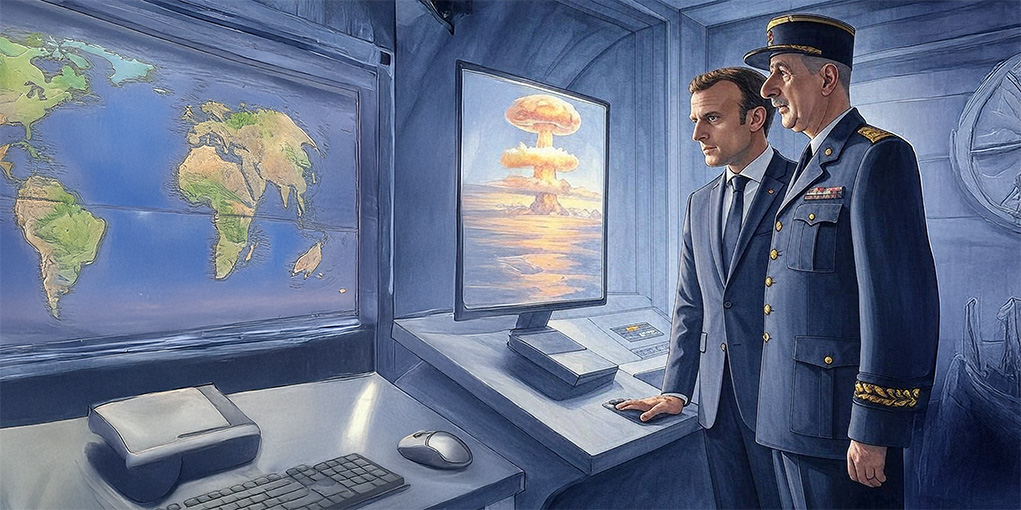
Macron’s statement that “the credibility of nuclear deterrence depends on strategic ambiguity” is like a magician’s sleight of hand: it keeps the audience guessing about the trick. If adversaries know exactly what actions will trigger a nuclear response, they might exploit that clarity by acting just below the threshold—through cyberattacks, limited military incursions, or other provocations. By keeping response conditions vague, a nation ensures adversaries must account for the worst-case scenario, much like a chess player who keeps their opponent off-balance by concealing their next move. This concept aligns with Mutually Assured Destruction (MAD), the Cold War doctrine where both the U.S. and Soviet Union understood that a first nuclear strike would lead to mutual annihilation—a standoff between two tightrope walkers, each too afraid to take a step that might send both plummeting. Strategic ambiguity reinforces MAD by ensuring neither side can predict the other’s precise response, maintaining the mutual fear that keeps the tightrope taut.
In the Indo-Pacific, this principle of reciprocal vulnerability—where all parties are equally exposed to catastrophic consequences—is like a house of cards, fragile yet balanced. France, the U.S., China, and others operate in a region where a single misplaced card could bring the whole structure down. Macron’s focus on ambiguity aims to preserve this delicate balance, ensuring that no actor feels confident enough to test the limits. This applies to basic deterrence, which protects a nation’s homeland, and extended deterrence, which France and the U.S. use to shield allies. By not specifying what would trigger a nuclear response—say, to defend a Pacific ally—Macron’s approach makes aggression a risky gamble, like betting on a roll of dice in the dark. He also alluded to the theoretical ideal of “perfect deterrence,” where no rational actor would attack due to overwhelming risks, though he cautioned that early transparency in the Ukraine war showed how easily such ideals can collapse like a poorly played hand.
Macron’s emphasis on ambiguity immediately brought to mind Robert Jervis’s book, Perception and Misperception in International Politics. Jervis argued that decision-makers’ perceptions of the world and other actors often diverge from reality in detectable patterns, shaped by cognitive biases, historical lessons, and psychological factors. He highlighted how misperceptions can lead to conflict, but also how deliberate ambiguity can serve as a tool to manage tensions. Jervis would likely assess Macron’s concept of strategic ambiguity as a double-edged sword. On one hand, ambiguity can deter aggression by amplifying uncertainty, as Macron suggested. Jervis notes in his book that states often overestimate the risks of escalation when they cannot predict an adversary’s response, a dynamic that aligns with Macron’s view that ambiguity strengthens deterrence by making adversaries cautious. For example, during the Cold War, the U.S. and Soviet Union often used vague signaling to avoid direct confrontation, a strategy Jervis describes as creating a “spiral of deterrence” where fear of miscalculation prevents escalation.
On the other hand, Jervis would caution that ambiguity can exacerbate misperceptions, leading to unintended consequences. He argues that decision-makers often project their own assumptions onto others, interpreting ambiguous signals through the lens of their biases. If a state perceives ambiguity as a sign of weakness rather than resolve, it might act more aggressively, risking escalation. Jervis cites historical examples like the 1962 Cuban Missile Crisis, where ambiguous U.S. signals initially emboldened Soviet actions until clearer threats forced a resolution. In Macron’s context, Jervis might warn that excessive ambiguity—say, about France’s response to a Chinese move in the Indo-Pacific—could lead Beijing to misjudge France’s commitment, potentially sparking a crisis. Jervis would likely advocate for a balanced approach, where ambiguity is paired with enough clear signaling to avoid catastrophic misperceptions, a nuance Macron’s speech acknowledged but did not fully address.
Other scholars of perception in international politics, such as Ole R. Holsti and Deborah Welch Larson, would offer complementary perspectives on Macron’s use of ambiguity. Holsti is known for his work on belief systems in foreign policy, argued in his study, “The Belief System and National Images,” that leaders’ perceptions are heavily influenced by their pre-existing beliefs, often leading to selective interpretation of information. Holsti would likely view Macron’s strategic ambiguity as a risky strategy in this context. Leaders in adversarial states like China or Russia, shaped by their own belief systems—perhaps viewing Western powers as inherently aggressive or unreliable—might interpret France’s ambiguous signals as either a bluff or a threat, depending on their predispositions. Holsti’s work suggests that ambiguity can reinforce existing biases rather than deter aggression, especially if communication channels are poor or trust is low, as has been the case with Russia since the Ukraine conflict began. For example, Holsti might argue that Putin, already skeptical of Western intentions, could misread Macron’s ambiguity as a lack of resolve, potentially emboldening further provocations in Europe or beyond.
Deborah Welch Larson, who has built on Jervis’s work, offers another lens in her book, Anatomy of Mistrust: U.S.-Soviet Relations During the Cold War. Larson focuses on how misperceptions and attribution errors shape state behavior, particularly during the Cold War. She argues that leaders often attribute an adversary’s actions to hostile intent rather than situational factors, a phenomenon known as the fundamental attribution error. Larson would likely assess Macron’s ambiguity as a potential trigger for such errors. If France’s ambiguous nuclear posture leads China to attribute a minor French military move in the Indo-Pacific— say, a naval exercise—as a precursor to escalation, Beijing might overreact, assuming hostile intent rather than defensive posturing. Larson’s work suggests that ambiguity, while useful for deterrence, requires careful management to avoid spirals of mistrust, especially in regions like the Indo-Pacific where historical grievances and strategic competition already fuel misperceptions. She might recommend that Macron pair ambiguity with confidence-building measures, such as diplomatic backchannels, to mitigate the risk of misinterpretation—a step Macron’s speech did not explicitly address.
This tension with ambiguity is particularly relevant to the “no first strike” doctrine, which many nations, including the U.S., publicly endorse to signal restraint. This doctrine promises not to use nuclear weapons unless attacked first, aiming to reduce the risk of preemptive strikes. Yet, as Macron suggested, maintaining ambiguity—hinting that a severe conventional attack might provoke a nuclear response—can create tension. While this vagueness strengthens deterrence by keeping adversaries cautious, it risks making them nervous, potentially leading to miscalculations, like a chess player who misreads an opponent’s bluff and makes a fatal move. Jervis would likely see this as a classic example of the “security dilemma,” where one state’s efforts to enhance its security (through ambiguity) make others feel less secure, potentially escalating tensions. Holsti might add that such ambiguity could reinforce adversarial belief systems, while Larson would caution against attribution errors that could spiral into conflict. Macron’s speech highlighted this balancing act, noting that the West’s early transparency in Ukraine allowed Russia to exploit perceived limits, a mistake he believes ambiguity could have prevented.
Macron’s emphasis on strategic autonomy, however, was equally significant, and it brought to mind the doctrine of Charles de Gaulle, France’s president from 1959 to 1969. De Gaulle’s “Politics of Grandeur” was rooted in the belief that France’s greatness depended on its strategic autonomy in global affairs, a vision of France as a tightrope walker navigating between the U.S. and Soviet Union without falling into either’s orbit. He sought to position France as a counterweight to both superpowers during the Cold War, rejecting any external control over French policy. In 1966, de Gaulle withdrew France from NATO’s Integrated Military Structure, asserting that France must control its own defense decisions, free from American dominance. This move was not a complete break from NATO—France remained a political member of the alliance—but it signaled a determination to prioritize national sovereignty, like a chess master refusing to play by another’s rules. De Gaulle also developed France’s independent nuclear deterrent, the Force de Frappe, to ensure the country could protect itself without relying on the U.S. nuclear umbrella, a move that gave France its own set of pieces on the global board. His vision extended to a Europe that could act as a third power bloc, balancing East and West while pursuing its own interests, a dream of Europe as a grandmaster in its own right.
De Gaulle’s doctrine, however, was not without contradictions. He demanded autonomy but often relied on NATO’s broader security framework, especially during crises like the Cuban Missile Crisis, where the alliance’s collective strength provided a safety net. His policies also faced criticism for inconsistency. For example, he supported Quebec’s autonomy movement while suppressing similar regional aspirations in Brittany, revealing the limits of his approach to self-determination. Moreover, his vision of a unified Europe under French leadership clashed with other European nations’ priorities, many of whom were more aligned with the U.S. Despite these challenges, de Gaulle’s legacy endures as a symbol of France’s ambition to maintain strategic autonomy, a goal Macron clearly seeks to emulate. At Shangri-La, Macron stressed the need for Europe to maintain strategic autonomy while navigating relations with the U.S., Russia, and China, particularly in the Indo-Pacific, where France aims to assert its presence without becoming entangled in U.S.-China rivalry.
Macron’s vision of autonomy, however, cannot be fully understood without examining France’s recent struggles in the Ukraine crisis, which began with Russia’s invasion in February 2022. Macron initially positioned himself as a mediator, engaging frequently with Russian President Vladimir Putin in the conflict’s early stages. He famously called for the West to avoid “humiliating” Russia, hoping to create space for a negotiated settlement, like a diplomat trying to broker a truce in a heated chess match. This approach, however, drew sharp criticism from Eastern European allies, who saw it as overly conciliatory and out of touch with the realities on the ground. These nations feared that Paris and Berlin would prioritize their own interests—such as maintaining economic ties with Russia—over collective defense, a misstep that left Europe’s chessboard unbalanced.
France’s support for Ukraine, while notable, was inconsistent and often overshadowed by these diplomatic missteps. France provided military aid, including Caesar howitzers, and supported Ukraine’s EU candidacy in June 2022. However, its contributions paled in comparison to those of the U.S., which supplied billions in weapons and financial aid, and even smaller nations like Poland, which became a key hub for Ukrainian refugees and arms transfers. Macron’s repeated calls to Putin yielded little, frustrating allies who felt France was undermining a unified, hardline stance against Russia, like a chess player who keeps offering draws instead of pressing the advantage. Former Estonian President, Thoomas Ilves highlighted that there is skepticism from Central and Eastern European nations stemmed from their concerns that France’s leadership in strategic autonomy might prioritize its own interests over collective European security. He emphasized that if France were to lead European security efforts while maintaining a cordial relationship with Russia, it would cause uneasiness among these countries. The Ukraine crisis exposed the limits of France’s vision: While Macron sought to lead a more autonomous Europe, his approach eroded trust among EU partners, many of whom doubled down on NATO as the bedrock of their security, a reminder that autonomy on the chessboard often requires allies to play along.
The policy consequences of pursuing strategic autonomy, as Macron advocated, are significant and multifaceted. One of the most immediate implications is the need for increased defense spending. To achieve true autonomy, Europe must reduce its reliance on the U.S. for security, which requires building its own robust defense capabilities, a move akin to adding more powerful pieces to the board. Macron has previously called for EU nations to increase defense spending beyond the NATO target of 3% of GDP. According to Stockholm International Peace Research Institute (SIPRI) data, France’s military expenditure in 2024 was approximately 2.1% of GDP, slightly above the NATO target but higher than Germany’s 1.9%. Across the EU, the average defense expenditure among member states in 2024 was around 1.98% of GDP, below NATO target, reflecting a historical underinvestment in defense due to reliance on the U.S. through NATO.
Raising defense spending to 5% of GDP would have profound economic and political implications, like a chess player sacrificing pawns to gain a strategic advantage. A 2025 report by Kosiak (2025) from Quincy Institute, projects that an increase to 5% GDP on military spending by 2034 would lead to an almost 90% increase in real (inflation-adjusted) annual spending compared to current levels. For France, with a 2024 GDP of approximately $3.16 trillion, this would mean increasing defense spending from $64.7 billion to $160.5 billion annually—a monumental shift. Germany, with a GDP of $4.66 trillion, would see its defense budget rise from $88.5 billion to $237 billion. Such increases would strain national budgets, diverting funds from social programs, infrastructure, and other priorities, potentially sparking domestic backlash. Politically, it could also hard-wire an arms race dynamic into the global economy, as other nations respond to Europe’s buildup with their own increases, further escalating tensions on the global chessboard.
Strategic autonomy also entails implementing policies of derisking and decoupling from China while simultaneously reducing energy reliance on Russia, a dual challenge that Macron’s speech implicitly acknowledged, like a chess player facing threats on two fronts. Derisking from China involves reducing Europe’s dependence on Chinese supply chains, particularly in critical sectors like technology, semiconductors, and rare earth minerals. A 2024 Bruegel and Merics report by Garcıá -Herrero and Vasselier (2024)notes that China’s state-led industrial policies have deepened Europe’s strategic dependence since the pandemic, with the EU’s role as a major exporter increasingly hollowed out. Decoupling efforts would require Europe to invest heavily in domestic production and diversify trade partners, a costly and time-intensive process, like rebuilding a chessboard mid-game. For instance, building a European semiconductor industry to rival China’s would require billions in subsidies and years of development, all while navigating potential Chinese retaliation, such as trade barriers or restrictions on rare earth exports.
At the same time, reducing energy reliance on Russia remains a pressing challenge, despite progress since the Ukraine invasion, a task akin to removing a critical piece from an opponent’s strategy without losing your own. The European Commission’s 2025 roadmap (2025), part of the REPowerEU Plan, notes that the EU has reduced its share of Russian gas imports from 45% in 2021 to 19% in 2024, but a rebound in imports that year underscores the difficulty of fully decoupling. Russia’s “shadow fleet” of vessels, used to evade sanctions, continues to supply oil to Europe, complicating efforts to phase out Russian energy. For France, which relies less on Russian gas than Eastern European nations but still imports significant amounts of Russian oil, achieving energy autonomy requires accelerating the transition to renewables and diversifying suppliers—steps that demand substantial investment and coordination across the EU, like a chess player repositioning pieces for a long-term advantage. The REPowerEU roadmap aims to end this reliance by 2027, but the economic costs, including higher energy prices, could fuel public discontent, especially in an already strained economic climate.
Macron’s Shangri-La Dialogue speech can be seen as an attempt to address these challenges while building on de Gaulle’s legacy, a move to position Europe as a grandmaster on the global chessboard. His call for strategic ambiguity in nuclear deterrence reflects a desire to avoid the transparency that hampered the West’s response in Ukraine, ensuring adversaries cannot exploit clear limits—a strategy Jervis, Holsti, and Larson would see as effective but risky due to the potential for misperception and mistrust. His push for autonomy seeks to revive de Gaulle’s dream of a Europe that can stand on its own terms amid great power blocs. In the Indo-Pacific, this means France positioning itself as a partner to nations wary of both U.S. and Chinese dominance, offering an alternative through its military presence and diplomatic engagement. Macron’s vision also aligns with France’s broader Indo-Pacific strategy, which includes strengthening ties with countries like India and Japan to counterbalance China’s influence.
Yet, the path to strategic autonomy is fraught with obstacles. The Ukraine crisis showed how quickly Europe reverts to U.S. leadership in times of crisis, a pattern that could repeat in the Indo-Pacific if tensions with China escalate. The economic and political costs of increased defense spending, derisking from China, and reducing energy reliance on Russia are immense, requiring a level of unity and resolve that the EU has struggled to achieve. Moreover, the risks of ambiguity in nuclear deterrence—miscalculation, escalation, or strained alliances—loom large in an era of hypersonic weapons and AI-driven warfare.
As I left the Island Ballroom at 10 PM, the weight of Macron’s words lingered. Strategic ambiguity and autonomy remain France’s guiding principles, rooted in de Gaulle’s legacy and informed by classic theories of perception in international politics, but tempered by the hard lessons of Ukraine and the realities of today’s geopolitical landscape. Can France lead Europe to true autonomy while maintaining the uncertainty that keeps nuclear conflict at bay? The chess game continues, and the next move is anyone’s guess.